Explorer’s Notes
📍 Location: Elephant Mountain, near Greenville, Maine
🚙 Getting There: The pavement eventually gives way to logging roads. The route is well marked, but expect rocks, washouts, and little to no cell service once you get into the woods.
🥾 Trail: Short and easy. Wreckage begins almost immediately and continues along the trail.
⏱️ Time to Explore: We spent about an hour and a half at the site.
💡 Good to Know: This isn’t just a historical site. Seven men died here. Treat the wreckage and the surrounding woods with respect.
I’d wanted to visit the B-52 crash site on Elephant Mountain for at least ten years.
I’m a nerd for history, and there’s something hard to wrap your head around about a B-52 still lying in the Maine woods more than sixty years after it crashed. It had been sitting on my list for a long time, but somehow I’d never made the trip.
I didn’t actually know that much about it.
I knew a B-52 had crashed somewhere near Greenville. I knew there was still wreckage in the woods.
That was about it.
Retta and I left Northport around seven that morning. Early-ish, although photography has completely destroyed my definition of what early means.
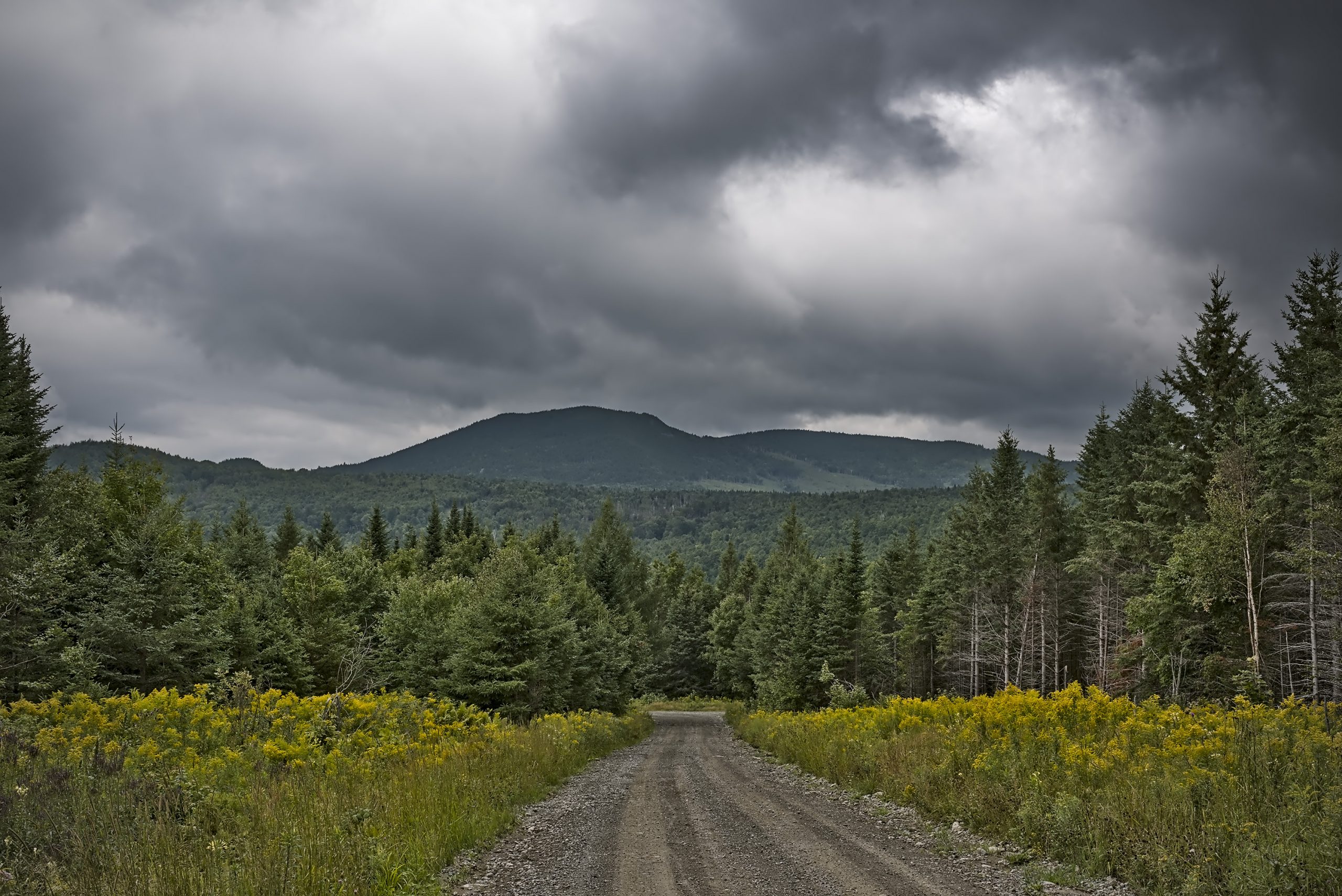
The drive toward Greenville was scenic and uneventful. There was some construction south of town, but otherwise the roads were in pretty good shape.
Then we left the pavement.
We took the Jeep, which seemed like the sensible choice once we got onto the logging roads. I’d wondered beforehand how my completely stock Jeep would handle them. They weren’t terrible, but there were some larger rocks and washouts that required a little attention.
Nothing dramatic. Straddle this. Avoid that.
And remember that logging trucks have the right of way.
Basically, get the hell out of the way.
We eventually lost cell service, which always makes a road feel a little more remote than it did five minutes earlier. Fortunately, the road to the memorial is well marked and we never had much trouble figuring out where we were going.
We pulled into a small parking area with room for maybe six or eight vehicles.
Then I saw a stock BMW SUV sitting there.
Apparently all my concern about whether the Jeep could make it had been unnecessary.
That was humbling.
It was late morning, overcast, foggy and drizzling a little. There were more people around than I expected. Considering we’d just traveled logging roads into an area without cell service, I figured we’d pretty much have the place to ourselves.
Not even close.
The trailhead is marked by a gate and several signs.
And before you even go through it, you see the engine.
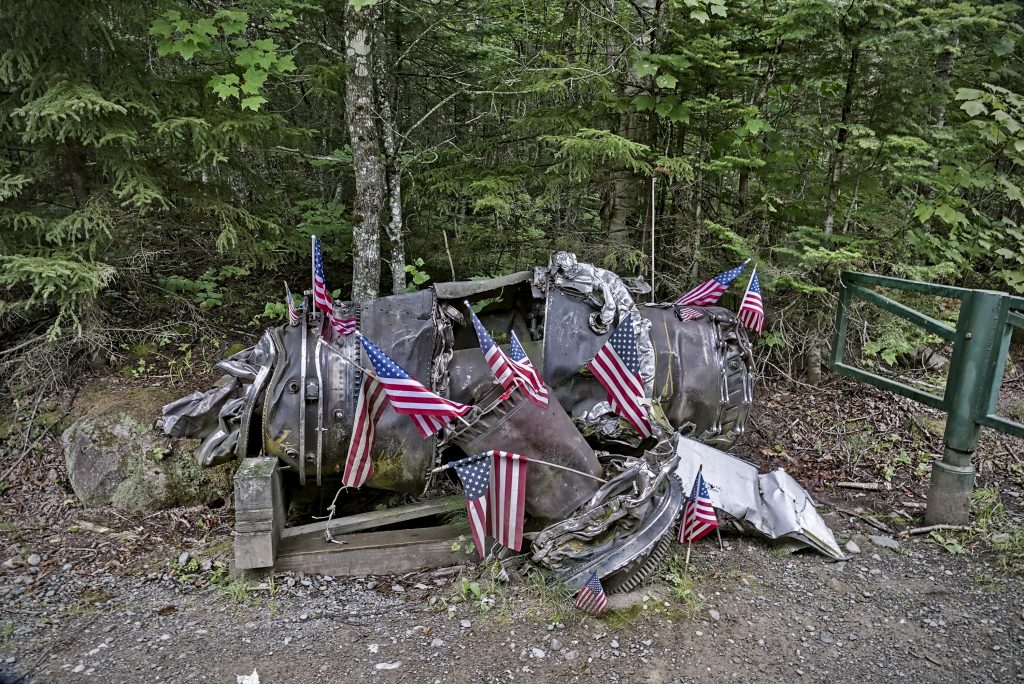
That caught me off guard.
I’d imagined smaller pieces of wreckage. Twisted bits of metal scattered around the forest floor that you’d have to study for a moment before realizing what they were.
Instead, one of the first things I saw was an aircraft engine sitting in the Maine woods.
It was a little unbelievable.
Then we went through the gate.
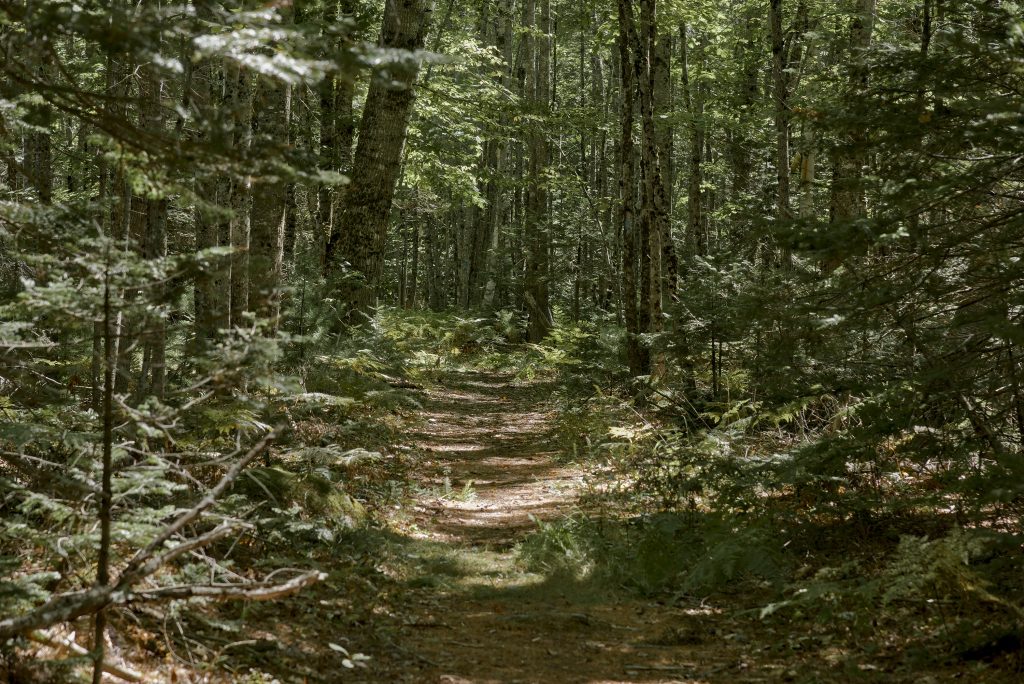
The trail was wide and easy to follow. The forest smelled damp from the drizzle, and despite the other people around, I remember it being strangely quiet.
Within a few feet, there was more wreckage.
Then more.
Some beside the trail. Some farther back among the trees.
I quickly realized I’d been completely wrong about how much of the airplane was still here.
This wasn’t a handful of fragments.
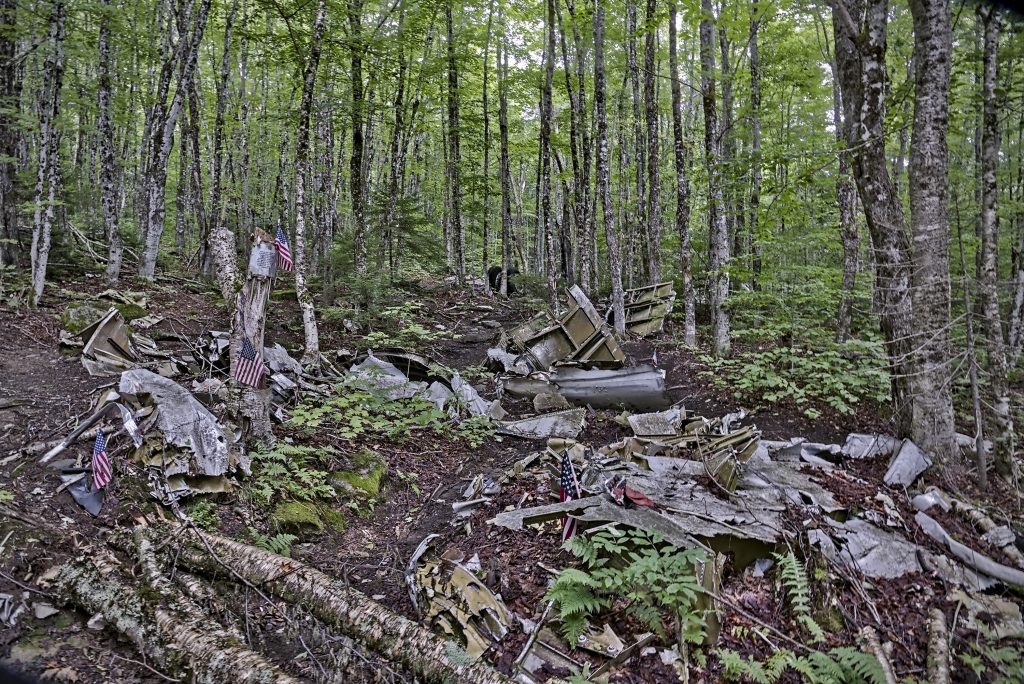
Pieces of the B-52 were scattered across the mountainside.
On January 24, 1963, a B-52C from the 99th Bombardment Wing at Westover Air Force Base in Massachusetts was flying a low-level training mission over Maine. Nine men were aboard. During the flight, the bomber encountered violent turbulence and lost its vertical stabilizer. Three crew members managed to eject before the aircraft crashed into Elephant Mountain. Lt. Col. Dante Bulli and Capt. Gerald Adler survived. The third man who ejected, co-pilot Maj. Robert Morrison, was killed, along with six other members of the crew.
Knowing that is one thing.
Standing in the wreckage is something else.
We kept walking.
There were pieces everywhere. Some were twisted beyond anything I could identify. Others needed no explanation at all.
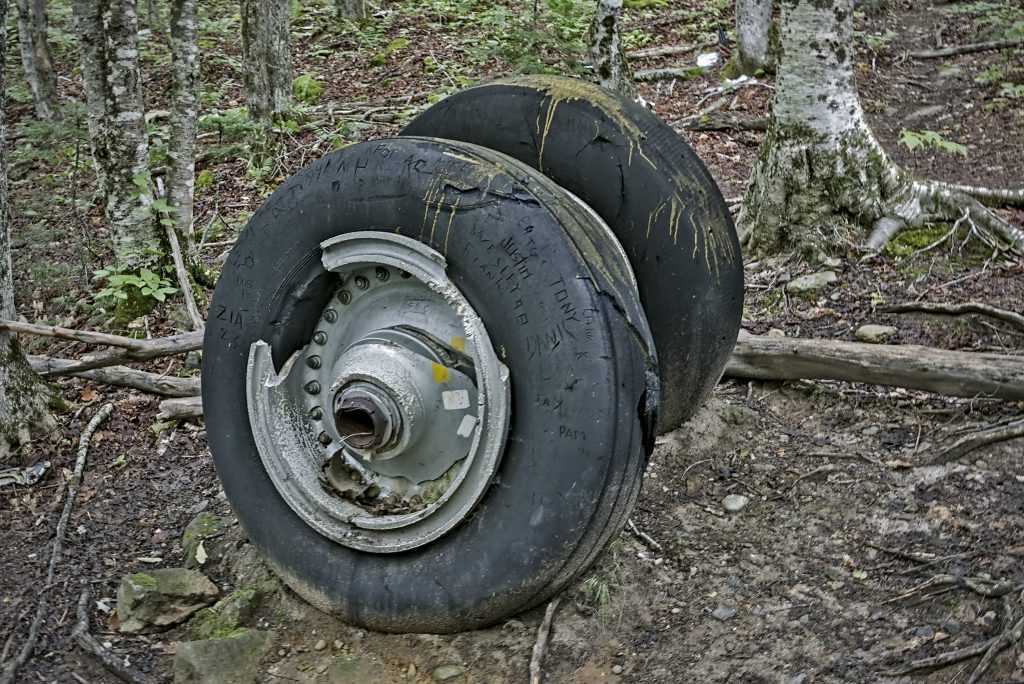
The landing gear was one of them.
Seeing those tires sitting among the trees really got me. Maybe because tires are so ordinary. You know exactly what you’re looking at, and suddenly the scale of the airplane starts to make sense.
Then there was the cockpit.
That’s the part I haven’t forgotten.
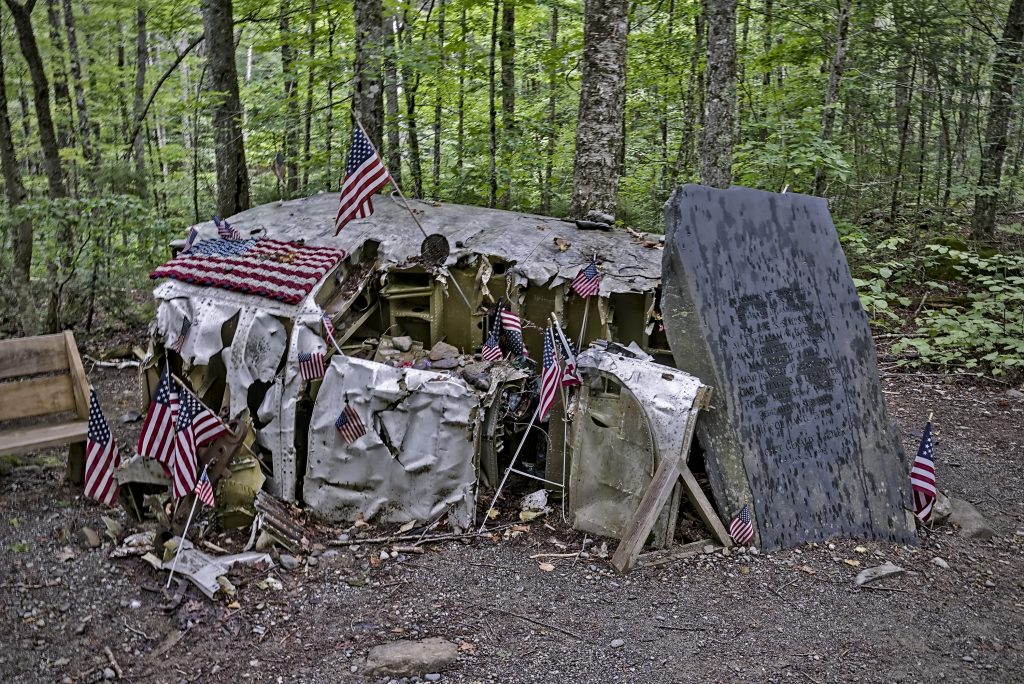
Enough of it remains that you can recognize what it was.
I stood there looking at it and tried to imagine the men who had been inside.
I couldn’t.
I took a lot of photographs that day. Mostly documentary photographs. Wreckage beside the trail. Pieces among the trees. Details that caught my attention.
The light wasn’t helping. Overcast skies above a dark Maine forest aren’t exactly a photographer’s dream.
But after a while, that stopped mattering very much.
There were several times when I had the camera in my hand and didn’t take a picture.
I just stood there.
Trees have grown around the wreckage over the decades. In some places they’re actually lifting pieces of the aircraft off the ground. Metal that fell here in 1963 is slowly becoming part of the forest around it.
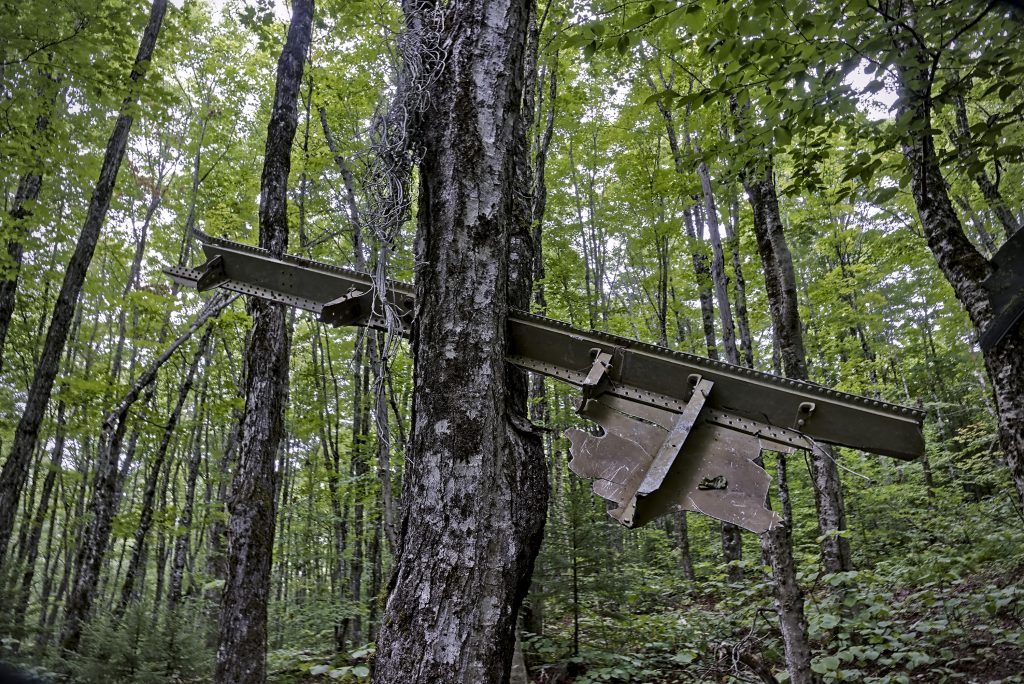
I found that strangely beautiful.
And a little eerie.
People have left things behind too. Small American flags. Military hats. Other reminders that people still come here specifically to remember the crew. Every January, the Moosehead Riders Snowmobile Club makes a trip to the crash site, and military personnel have joined the commemorations over the years.
One of my favorite photographs from the trip is a small American flag sticking out of a tree with wreckage behind it.
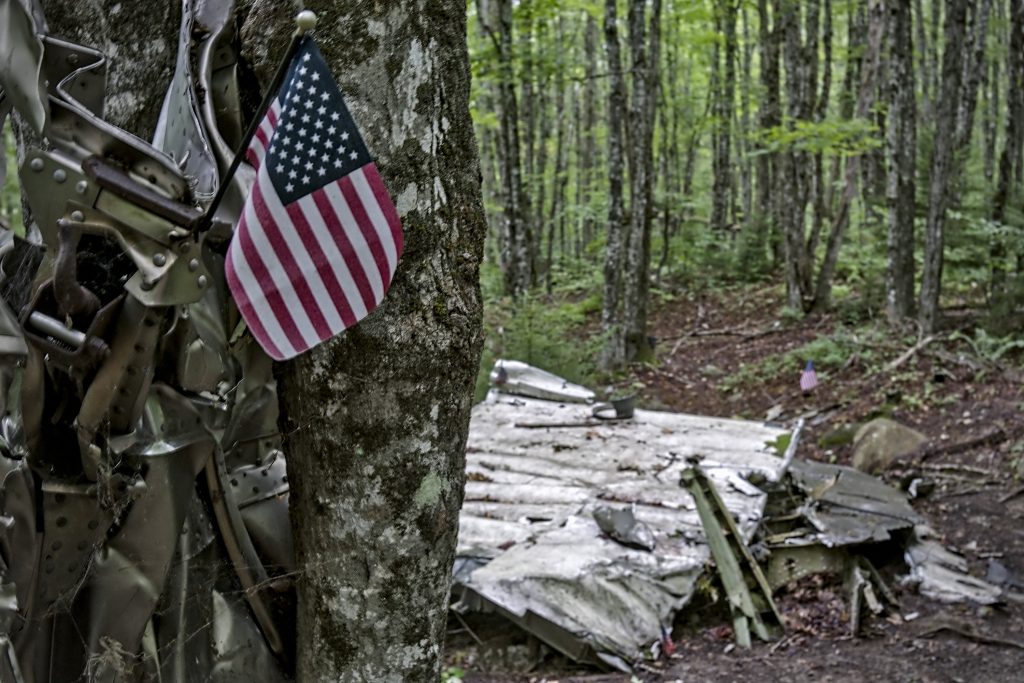
It’s not the biggest piece of the airplane.
It’s probably not even the photograph most people would take.
But something about it worked for me.
By then, the way I was looking at the place had changed.
I’d arrived excited. I’d finally made it somewhere I’d wanted to visit for ten years. There was the Jeep ride in, the logging roads, the camera, and that feeling I always get when I’m exploring somewhere new.
Somewhere along the trail, that wore off.
It stopped feeling like I’d come to see a B-52 crash site.
It felt like a cemetery.
Seven men died on this mountainside.
Once that really sank in, I couldn’t look at the wreckage the same way.
The Air Force records that temperatures fell far below zero that night. Bulli used a sleeping bag from his survival equipment, while Adler wrapped himself in his parachute. Rescuers reached the two men the following day.
Standing there on a humid August day, it’s hard to imagine what that night must have been like.
I don’t think I really can.
We spent about an hour and a half wandering around before finally heading back.
The walk out was different.
Nothing around us had changed. Same trees. Same trail. Same pieces of aluminum scattered through the woods.
But I wasn’t walking out with the same excitement I’d carried in.
Retta and I talked about how much wreckage was still there. Neither of us had expected anything close to it.
I kept thinking about the cockpit.
I still do.
Of everything I photographed and everything we saw, that’s what comes back first. That recognizable piece of an airplane sitting quietly among the trees.
I think about the men who were inside it.
I think about the people who went into those mountains looking for them.
And I think about how strange it is that more than sixty years later, you can still walk into those woods and stand among what remains.
Eventually we made it back to the Jeep.
I climbed in after spending the better part of two hours thinking about history, survival, loss, and everything we’d just seen.
And almost immediately had another thought.
How the hell do I get back to pavement?
Keep Exploring
I went to Elephant Mountain because I’d wondered about the place for ten years.
I expected some wreckage in the woods.
I wasn’t prepared for how much was still there, or how recognizable some of it would be.
The landing gear surprised me.
The engine stopped me before I’d even entered the trail.
But neither is what followed me home.
That was the cockpit.
It’s still there among the trees.
And I still don’t quite know what to do with that.