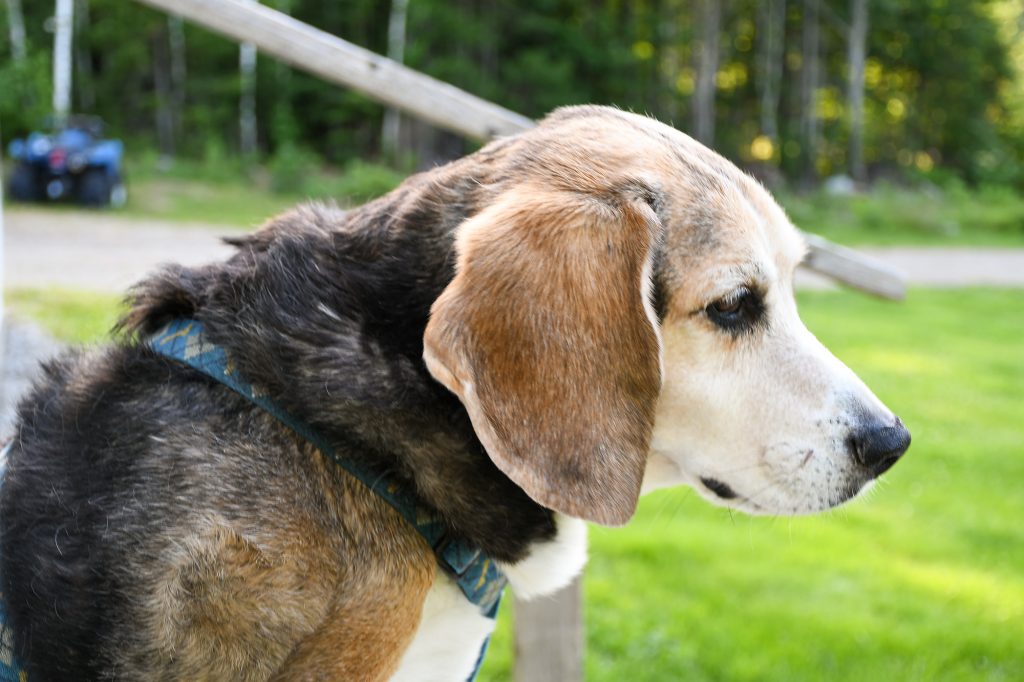
This is one of the first photos I ever took with my Nikon D7500.
Not the first. But close. Early enough that I was still fumbling through menus, second-guessing settings, and wondering if I’d just wasted money on a camera I didn’t know how to use.
It’s a simple shot. A dog in profile. Natural light. Backyard. Nothing dramatic. Nothing that would win awards or make anyone stop scrolling.
But it mattered.
Because at the time, my backyard was about as far as I could go.
Before the “Real” Camera
Before the D7500, I shot with my phone.
And look—phone cameras are good now. Better than they used to be. But there’s a ceiling. You can’t control depth of field. You can’t really shoot in low light without everything turning to mush. You’re stuck with what the phone thinks the scene should look like, and sometimes the phone is wrong.
I wanted more control. I wanted to learn actual photography. Aperture, shutter speed, ISO. The stuff that matters when you’re trying to capture light the way you actually see it, not the way an algorithm thinks you should.
So I bought the D7500. Entry-level DSLR. Budget-friendly. Beginner-friendly. The kind of camera that doesn’t judge you for not knowing what you’re doing yet.
I was excited. And terrified.
Because now I had a tool that could do incredible things—if I could figure out how to use it.
Limited Range
Here’s the part that made it harder: I wasn’t mobile.
This was during the worst of my hip problems. Before the replacement. Before physical therapy. Before I could even think about hiking a trail or walking more than a few hundred feet without paying for it.
I couldn’t drive to a scenic overlook. I couldn’t hike to a waterfall. I couldn’t chase golden hour light on a ridgeline somewhere remote and beautiful.
I had my yard. My driveway. Maybe the street if I was feeling ambitious.
That was it.
And at first, that felt limiting. How do you learn landscape photography when you can’t get to the landscapes? How do you practice when your world has shrunk down to a few hundred square feet?
But then I realized: you learn to see what’s already there.
Finding the Shot
The dog in the photo—patient, still, looking off toward something I couldn’t see—was right there. In the yard. On an ordinary afternoon when the light happened to be good.
I grabbed the camera. Set it to aperture priority because I was still too intimidated to shoot full manual. Focused. Clicked.
The background blurred. The fur had detail. The light hit just right.
It wasn’t perfect. The composition could’ve been tighter. The exposure was a little off. But it was better than anything I’d shot with my phone. And for the first time, I understood what depth of field actually meant—not as a concept in a tutorial video, but as something I could see and control.
I took maybe twenty more shots after that. Different angles. Different settings. Most of them worse. A few of them better.
And by the end, I felt like maybe I hadn’t wasted my money after all.
What I Learned Shooting Close to Home
When you can’t go far, you have to get better at seeing.
I started noticing light differently. The way it changed through the day. The way shadows moved across the yard. The difference between harsh noon sun and soft late-afternoon glow.
I started paying attention to small details. Textures. Patterns. The way moss grew on the stones near the driveway. The way tree branches framed the sky.
I practiced settings without the pressure of missing a once-in-a-lifetime shot. If I screwed up the exposure, I could try again five minutes later. The subject wasn’t going anywhere.
And I learned that you don’t need an epic location to make a good photograph. You just need good light and something worth looking at. Sometimes that’s a mountain. Sometimes it’s a dog in your backyard.
The Camera That Started It All
The D7500 has been good to me.
It’s not the best camera Nikon makes. It’s not full-frame. It’s not cutting-edge. But it taught me how to shoot. It got me through the worst of my hip problems when I couldn’t go anywhere. It’s been to Cutler Coast, Vaughan Woods, and dozens of trails in between.
I’m ready to upgrade now. But I won’t forget what this camera did for me.
It gave me something to focus on when I couldn’t walk. It taught me to see light. It reminded me that you don’t need to go far to make something worth keeping.
And it took this shot—a simple portrait of a dog on an ordinary afternoon—that still sits in my catalog as a reminder of where I started.
Not with epic landscapes or dramatic vistas.
Just with what was right in front of me.
Sometimes, that’s enough.